
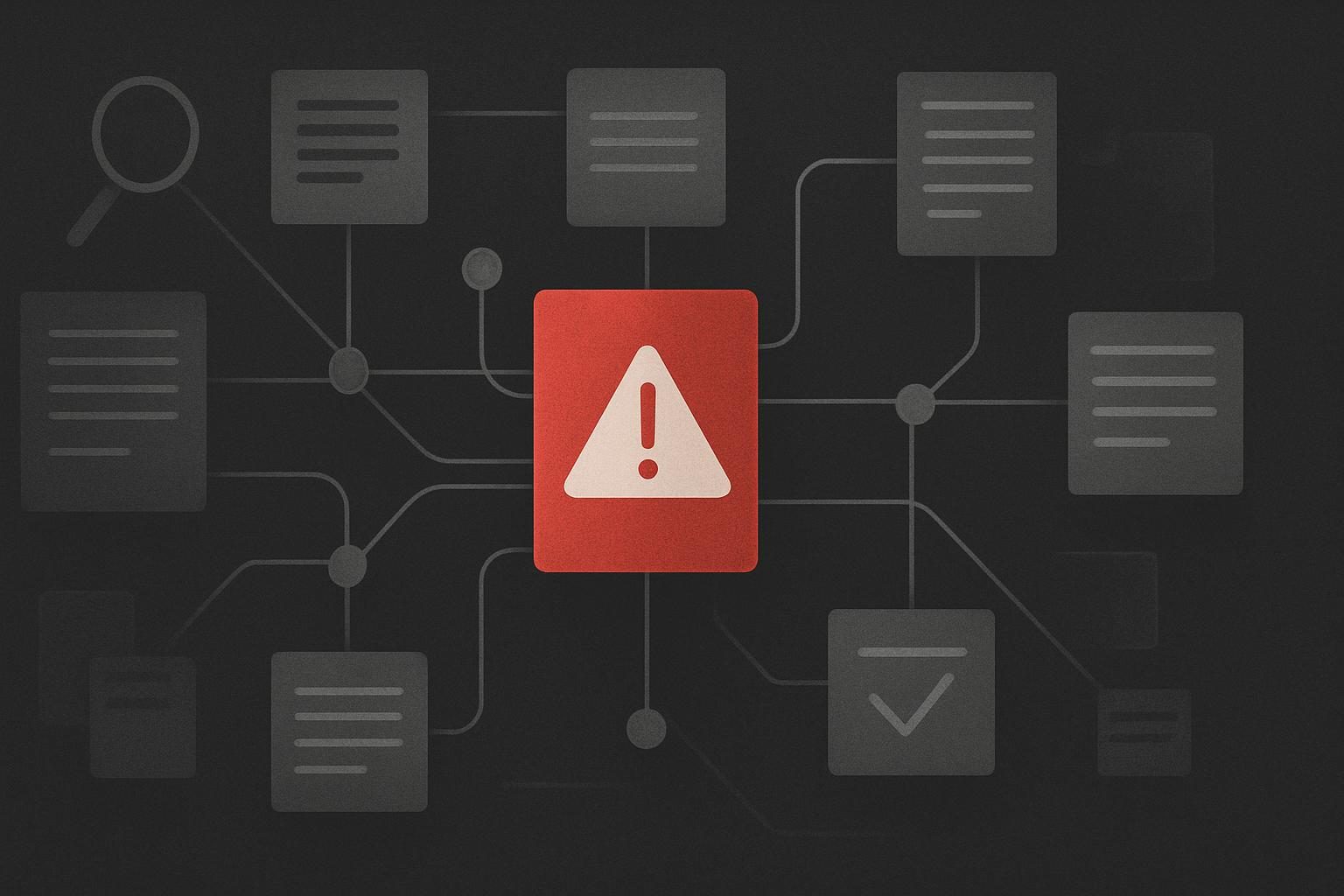
ChatGPT says a consultancy offers broad digital marketing services. It stopped offering them last year. The statement is confident, specific and wrong, but its source has not yet been proven.
That distinction matters. A team in Dubai, the UAE or any other market can spend days rewriting service pages, editing schema and chasing directory listings because one AI answer looks alarming. They may improve things, or they may simply make it impossible to tell what reinforced the original error.
One wrong business fact should be handled as a provenance incident. Capture the claim, trace plausible surviving versions of it, make the narrowest justified correction, then retest the same fact. Only widen the work when the investigation finds evidence of broader entity drift.
Freeze the disputed statement before changing anything
Do not work from memory or a paraphrase. Save the exact prompt, the full answer, the platform, date, account state where relevant, location setting and any cited or linked sources. AI answers can vary, so the wording is part of the incident record.
Then write two short lines:
- Disputed claim: what the AI answer said.
- Correct fact: the precise, current description the business can substantiate.
Be strict about the difference. Saying a firm is a digital marketing agency is not identical to saying it provides paid media services. A company may still be adjacent to an old category without actively selling it. Loose corrections create loose searches.
Name the type of error before hunting for a source
Classification narrows the search. Most incidents fall into a few predictable groups:
- Stale fact: an old service, former office, previous brand name or retired leadership role.
- Over-broad category: a specialist business labelled with the larger category it used to sit within.
- Entity confusion: the answer appears to combine the business with a similarly named company, founder or local competitor.
- Inference: the model turns related information into a stronger claim than the evidence supports.
- Untraceable answer: no public source reproduces the statement closely enough to establish a plausible origin.
This is not a philosophical exercise. A stale partner profile needs a different response from a name collision. A full website rebuild is unlikely to solve either.
Search for the sentence and the versions a model could invent
Start with the disputed category or description in search engines, site search and the business’s own content estate. Search the exact phrase where it is distinctive, then use close variants: singular and plural forms, older service names, abbreviations, city modifiers and the language a directory might use.
For a consultancy wrongly described as offering broad digital marketing, useful searches might include the former category, its service subtypes, the company name plus that category, and senior staff names plus that category. Search quoted phrases selectively, but do not rely on exact matches. Old sources often compress or rewrite the same idea.
Check controlled sources first, without turning this into a general clean-up. That usually means the relevant service page, older blog posts, downloadable PDFs, speaker biographies, careers pages and structured data attached to the page. A common boring failure is a retired service page that now redirects, while its visible copy or JSON-LD still describes the old offer. Inspect the rendered page and page source, not only the CMS editor.
Look outside the site only after you have a plausible phrase
If first-party pages do not explain the claim, look for sources that had a reason to publish the old description: partner directories, event biographies, trade profiles, association listings, marketplace pages and old announcements. Archived or syndicated material can outlive a service change by years.
In the consultancy example, the team finds an old partner profile calling the firm a full-service digital marketing consultancy. The main website no longer says this. The partner description is a plausible surviving source, so it becomes the first correction target.
Once a likely third-party source has been identified, use a third-party source repair process to decide whether the source is editable, worthwhile and likely to need supporting corrections elsewhere. Do not assume every mention deserves equal effort.
What counts as a traceable source?
A traceable source is not proof that an AI platform read one page and repeated it verbatim. Public evidence rarely gives that level of visibility into model behaviour. It is a source that contains the disputed fact, or a materially similar version, and is credible enough to be a plausible reinforcement point.
The useful threshold is practical: can you identify a specific page or profile whose correction would remove a visible contradiction? If yes, record the URL, wording, publisher, access status and date checked. Then correct the narrowest source you can justify.
Do not add compensating claims everywhere. If one partner profile is wrong, correct that profile. Avoid adding a dozen defensive sentences to the website saying what the business does not do. They can make the offer less clear for buyers and machines alike.
Verify the correction as a publishing event
A request sent to a directory is not a correction. Check the live public page after the update, including the rendered text, canonical URL and any structured data that still carries the old category. If the source is cached, syndicated or controlled by someone else, record that too. The aim is to know what changed, not to declare victory from an email thread.
Keep a small incident log with the original answer, suspected source, live correction date and retest date. This is deliberately less dramatic than rebuilding an entity record. It is also more useful when someone asks six weeks later why the answer changed, or did not.
Retest the same fact, not a friendlier prompt
Retest with the original wording first. Use comparable conditions where possible, then add one or two close prompts designed to expose the same disputed claim. Do not replace it with a branded prompt that invites the platform to repeat your preferred description.
One changed answer is an observation, not conclusive attribution. The result may persist, disappear or vary across ChatGPT, Gemini, Perplexity, Copilot and Google AI experiences. Record that outcome without claiming a direct causal link unless the platform itself provides evidence.
When one bad fact becomes an entity audit
Escalate when the investigation uncovers multiple independent contradictions: several current pages disagreeing on the core offer, structured data naming a different business category, important external profiles repeating incompatible facts, or recurring confusion with another entity. At that point, a business entity audit for AI search is more appropriate than another isolated correction.
The trigger is evidence of a pattern, not irritation with one bad answer. Trace the claim first. Repair the graph only when the incident shows the graph is actually broken.
Questions about wrong business information in ChatGPT
How can I find where ChatGPT got a wrong business fact?
Capture the exact wording, classify the error and search for close versions across your own pages and plausible third-party profiles. Look for stale service pages, biographies, directories, partner listings and archived descriptions. You may find a plausible source, but public evidence usually cannot prove that ChatGPT used one particular page.
What if no public source contains the wrong claim?
Treat it as untraceable rather than inventing a cause. The answer may reflect entity confusion, an inference from adjacent facts, historical material that is no longer easy to find or platform behaviour that cannot be inspected. Confirm your current core description is clear, then monitor the same incident before making broad changes.
When should one wrong AI answer trigger a full entity audit?
Escalate when the investigation reveals several contradictions across important business facts, repeated confusion across prompts or platforms, or inconsistent first-party and third-party descriptions. One isolated stale profile usually calls for a narrow repair. A pattern involving category, location, services or ownership needs a wider evidence review.